Serving Madera, CA and surrounding areas. (559) 831-0855
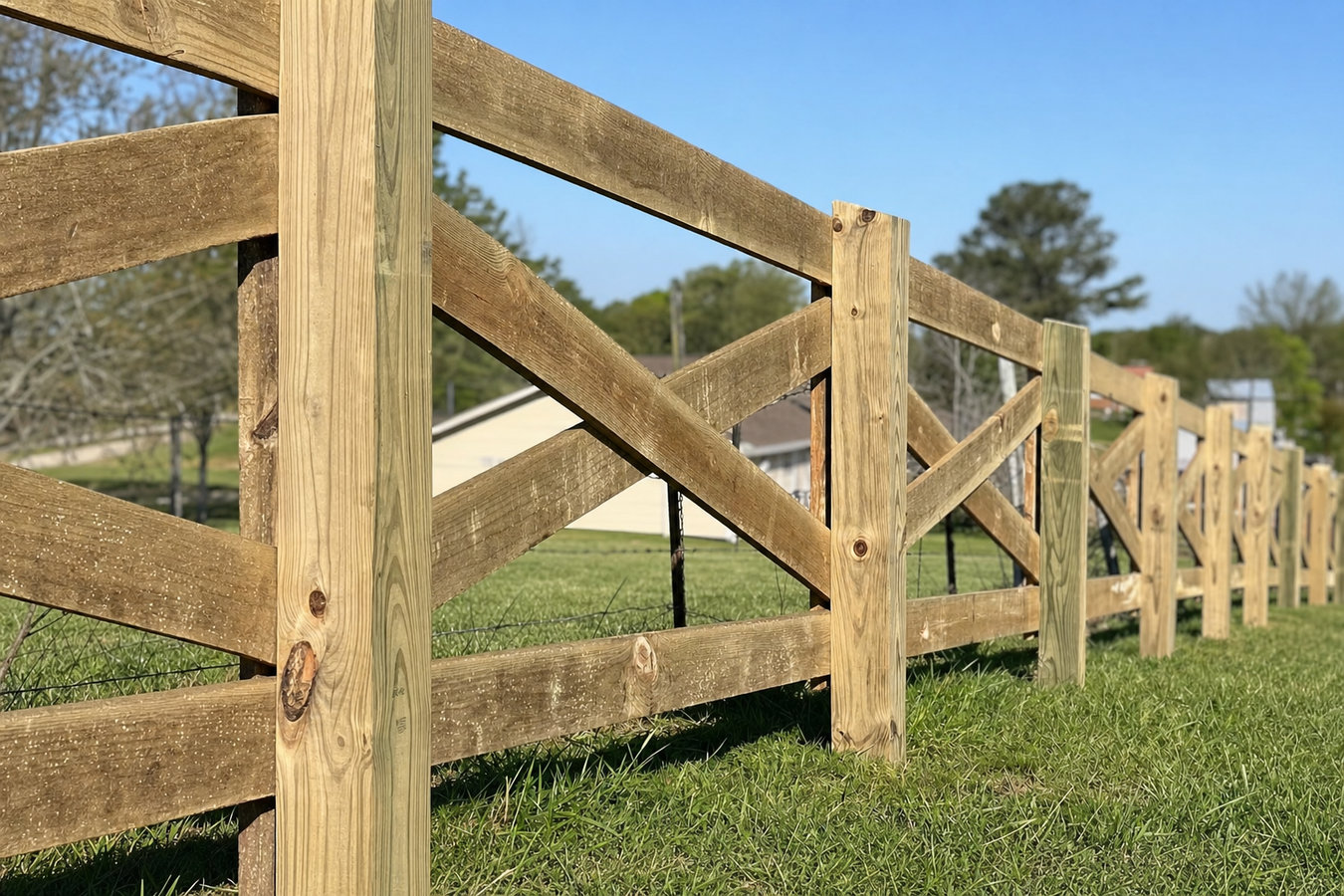
Agricultural land in the San Joaquin Valley needs fencing that holds through shifting soils, seasonal winds, and years of daily use. We install farm and ranch fencing in Madera sized and set for the conditions your property actually faces.
Farm and ranch fencing in Madera covers perimeter fencing around a property, interior cross-fencing to divide pastures, and livestock-specific barriers matched to the animals you are managing. Common types include woven wire, high-tensile wire, wood post-and-rail, barbed wire, and pipe steel. A straightforward perimeter fence on a small to mid-size property typically takes one to three days for a professional crew - larger ranches or rocky ground can stretch to a week or more.
Landowners in Madera reach out when existing fences fail after years of clay soil movement, when they are adding new animals that require a different type of fence, or when they are buying or selling agricultural property and need a clear, functional boundary. The right material depends on what you are containing and how much maintenance you want over time. For properties where livestock are near the main house, we can also discuss how pet and dog fencing ties into the overall property layout.
Walk your fence line and push on each post with both hands. If a post rocks or leans noticeably, it is no longer doing its job. In Madera's clay soils, this often happens gradually as the ground swells and shrinks through wet winters and dry summers - it is not always poor original work, but it does mean the fence needs to be reset before the problem spreads to adjacent sections.
Sagging wire between posts means tension has been lost - either the wire has stretched over time or posts have shifted. Gaps at the bottom of a fence are especially urgent if you are keeping goats, sheep, or young livestock, who are remarkably good at finding any opening that appears. A small breach that goes unnoticed can turn into an escaped animal and a much bigger repair bill.
If you have recently acquired additional land or are planning to add a different type of livestock, your existing fencing may not be adequate for the new use. Different animals need different fence heights, wire gauges, and post spacing - what works for cattle will not necessarily contain horses or small animals safely. Getting the right fence in place before the animals arrive is always better than dealing with escapes after the fact.
The San Joaquin Valley experiences strong seasonal winds, particularly in spring, that can knock over weakened posts or pull wire loose from staples. After any significant wind event, walk your entire fence line to check for damage. A small breach that goes unnoticed can lead to escaped livestock or a much larger repair cost if more sections begin to fail over the following weeks.
Madera Fences installs agricultural and ranch fencing in woven wire, high-tensile wire, barbed wire, wood post-and-rail, and pipe or tube steel - matched to the animals you are managing and the soil conditions on your specific property. Before any digging starts, we check for irrigation easements that could affect where your fence can legally go - a step that matters on Madera County agricultural land where the Madera Irrigation District's canal network creates setback requirements many landowners are not aware of. For properties with dogs or working animals that need a separate contained area near the main house, we can connect that work with our chain link fence installation service, which is well-suited to yard enclosures on agricultural parcels.
Every job starts with a site walk - we look at soil conditions, existing fence lines, equipment access, and any obstacles like trees, ditches, or irrigation infrastructure before we quote anything. You receive a written, itemized estimate after that visit, not a vague total number. Posts are set to the depth required by your soil type, and wire is tensioned to a standard that holds through Madera's seasonal winds. We also confirm permit requirements for your specific property before work begins - most agricultural fencing in rural Madera County does not require a building permit, but it depends on location and proximity to roads or waterways.
Suits properties managing cattle, sheep, goats, or mixed livestock - adjustable mesh sizes keep different animals contained without requiring separate fence lines.
Suits horse properties where smooth fencing is essential - barbed wire is not appropriate for horses, and wood rail provides a safe, highly visible boundary.
Suits high-traffic areas like loading pens, corrals, and entry gates where durability matters more than cost - pipe steel typically lasts 40 years or more with minimal maintenance.
Suits cattle operations and large perimeter runs where cost per linear foot matters - appropriate for cattle but not for horses or properties with young children present.
Madera County is one of California's most productive agricultural counties - the land here is working land, and the fencing that goes on it has to perform accordingly. The clay-rich soils throughout this part of the San Joaquin Valley expand when wet and shrink when dry, putting real stress on fence posts over time. A contractor who does not know this soil behavior will set posts the same way they would in stable sandy ground - and you will be dealing with leaning sections within a few years. The strong spring winds that roll through the valley are also harder on fencing than most people expect, particularly on high-tensile wire that was not tensioned correctly. Landowners in Chowchilla face the same soil and wind conditions - local knowledge of how to handle both is what separates a fence that lasts from one that needs repairs every other season.
The Madera Irrigation District's canal network is another factor that affects where fences can go on agricultural parcels in this area. Placing a fence inside an irrigation easement - without knowing it is there - can mean being required to remove and relocate the fence at your own expense. We check for these easements before layout begins, because it is easier to work around them from the start than to move a completed fence. Properties in Mendota and the surrounding western valley share similar canal infrastructure situations, and the approach is the same - identify easements early, then build around them correctly.
For properties in Madera County's foothill areas where wildfire risk is a real concern, wood fencing near structures can act as a fire pathway. The California Office of the State Fire Marshal designates fire hazard severity zones, and UC Agriculture and Natural Resources provides guidance on livestock fencing options suited to California's varied conditions - including fire-prone areas.
Call or submit a request and we reply within one business day. We will ask about your property size, what animals you are managing, and what you need the fence to accomplish. Even a rough idea of how many linear feet you need helps us give you a useful first response before we schedule a site visit.
For any project beyond a small repair, we walk the property with you before quoting. We look at soil conditions, existing fence lines, equipment access, and any obstacles like irrigation ditches or canal easements. After the visit, you receive a written, itemized estimate - not a single total number with no breakdown.
We confirm whether a permit is needed for your specific property before any digging starts. We also contact 811, California's free utility locating service, to have underground lines marked - this is required by law and protects everyone on the job. This step typically takes a few business days and is built into the project timeline.
Corner and gate posts go in first - these anchor the entire fence line. Line posts follow, then wire or boards are attached and tensioned. Once installation is complete, we walk the fence with you, confirm gates latch correctly and wire is tight, and remove all debris and leftover materials before leaving your property.
We walk your property with you before we quote anything. No vague numbers, no surprises on the final invoice - just a clear, itemized estimate you can actually compare.
(559) 831-0855Madera's clay-rich soils expand in winter rains and crack in summer heat - that cycle repeats every year and gradually pushes fence posts out of alignment if they were not set deep enough from the start. We account for local soil conditions in how we size and anchor every post, so your fence stays straight and tight through seasonal change, not just the first year after installation.
The Madera Irrigation District's canal network crosses through many agricultural properties in this county. Placing a fence inside an easement without knowing it is there can mean relocating the entire run at your own expense. We check for easement locations before a single post is placed - it is easier to design around them from the start than to move a finished fence. This is a step many out-of-area contractors skip entirely.
Different livestock require genuinely different fencing - barbed wire is dangerous for horses, goats need tight mesh with no bottom gaps, and cattle containment requirements differ from those for sheep. We ask about your specific animals before recommending any materials, because the wrong fence type for your operation costs you time and money when it fails. The American Fence Association provides installation standards we reference on every agricultural job.
One of the most common complaints about fencing contractors in this area is vague quotes that grow once work starts. Every quote we provide is written and itemized - materials, labor, gate hardware, and any additional costs like concrete or soil conditions are listed separately. You can compare our quote to others on equal terms and know exactly what you are agreeing to before anyone picks up a shovel.
Agricultural fencing in Madera County is not the same as residential fencing. The scale is different, the soil is different, and the legal landscape around easements and agricultural zoning adds steps that residential jobs do not have. We bring the same written-quote, local-knowledge approach to every farm project that we bring to every backyard job - because you deserve to know what you are paying for.
Contained yard enclosures for dogs and small animals - sized and secured for animals that test fences more than livestock do.
Learn MoreGalvanized chain-link for yard boundaries, utility enclosures, and secondary containment areas on larger agricultural properties.
Learn MoreMadera's best installation weather is spring and fall. Call today or request a free estimate to lock in your project date before the summer heat and busy season arrive.